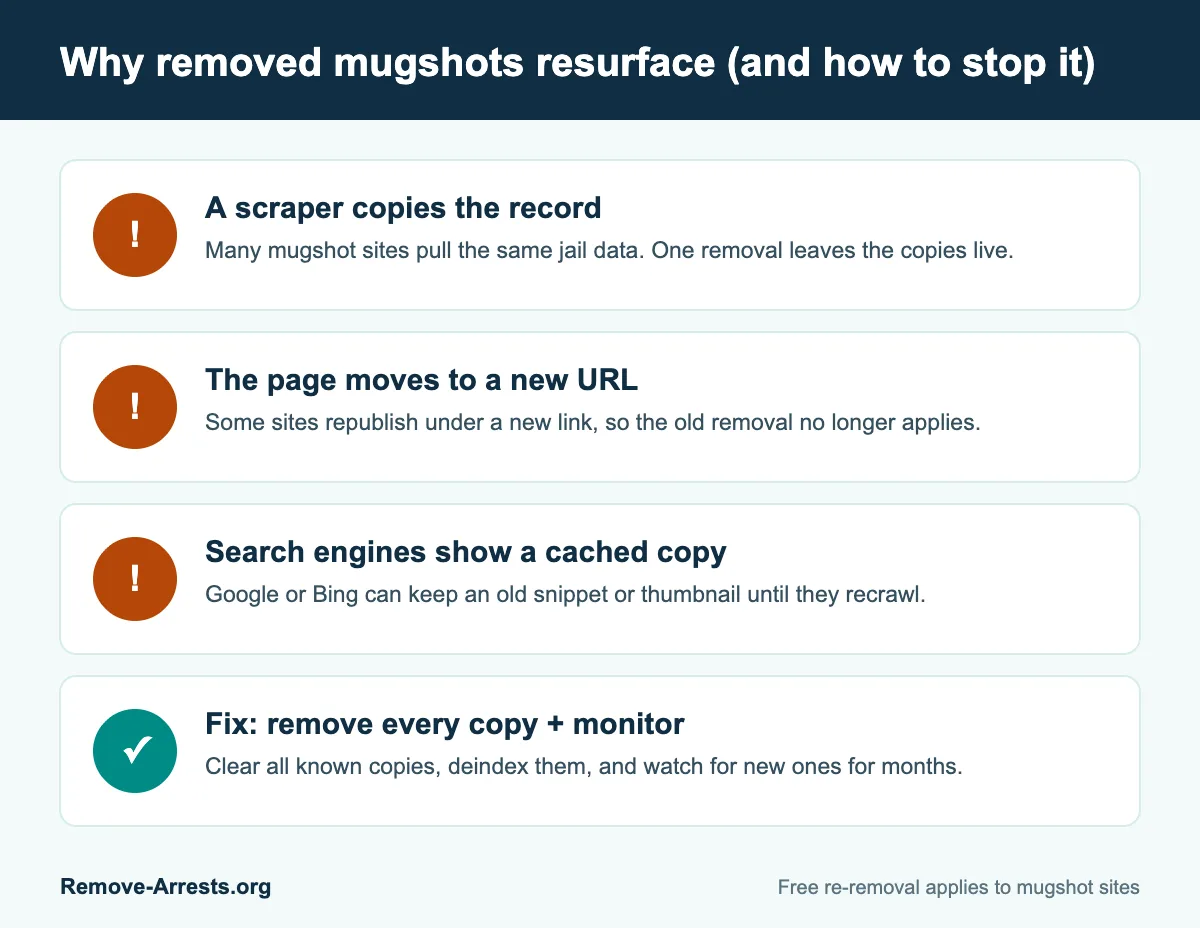
A properly removed mugshot should not come back on the site that took it down. When a mugshot “comes back,” it is almost always a different copy: another mugshot site that scraped the same booking record, the same record republished at a new URL, or an old search engine snapshot that has not refreshed yet. Removing every copy, deindexing each one and monitoring for new ones is what keeps it gone.
That distinction matters, because it tells you what to ask for before you pay anyone. A removal that only covers one link can leave three more copies live. A removal backed by monitoring and a free re-removal promise gives you a way to fix a repost without starting from scratch.

Why a removed mugshot can show up again
Most people who say their mugshot “came back” are looking at one of four situations. Each has a different fix, so it helps to know which one you are dealing with before you contact anyone.
1. Another site scraped the same booking record
County jails and sheriff’s offices publish booking data, and dozens of commercial mugshot websites copy it automatically. When one copy is removed, the next copy can move up in Google and look like the same listing returned. In reality, it was there the whole time, just lower in the results.
2. The site republished the record at a new URL
Some sites rebuild their pages, change their URL structure or move to a new domain. The record you removed at one address can appear at another. A good removal provider tracks the record itself, not just the old link.
3. Search engines are still showing a cached copy
Google and Bing do not refresh every page instantly. After a source page is deleted, the search result, snippet or image thumbnail can linger until the crawler comes back. That is why removal includes a deindexing step through tools like Google’s outdated content tool and Bing’s Content Removal Tool.
4. A new arrest or a news story created a new record
A second booking, a court update or a local news article creates a brand-new page. That is not a removal failure, but it does need its own plan. News articles follow different rules than mugshot sites, so they are handled separately.
How long does a mugshot removal last?
For commercial mugshot sites, a completed removal is meant to be permanent. Once the site deletes or blocks the record and search engines drop it, there is nothing left for Google to show. Our team has removed mugshot-site pages for years, and those removed pages do not return on the same site.
What you cannot control is what other websites do in the future. New mugshot sites launch, scrapers pick up old county data, and some people get re-listed months later. That is why the realistic answer to “is mugshot removal permanent?” is: yes for each page that is removed, as long as someone is watching for new copies.
What a real mugshot removal guarantee should cover
A guarantee is only as good as its details. Before you hire anyone, ask these questions and compare the answers side by side. Our comparison of mugshot removal services walks through how different companies handle them.
| Question to ask | Good answer | Red flag |
|---|---|---|
| What if the mugshot is reposted? | Free re-removal for a set period, in writing | “That would be a new job” |
| Does removal include Google and Bing? | Yes, source site plus search engines | Only the source site |
| What if the removal fails? | Full refund on the agreed links | No refund policy |
| Do you remove every copy? | Search for all copies and quote each one | Only the link you send |
| Do you monitor afterward? | Ongoing checks or a monitoring option | No follow-up at all |
At Remove-Arrests.org, mugshot removal is guaranteed: the record is removed from the source site plus Google and Bing in 7 to 14 business days, or you get a full refund for that link. If a mugshot-site page we removed comes back, we remove it again at no extra cost. You can read the step-by-step details on our removal process page.
How to keep your mugshot from coming back
You do not need to check Google every morning. A short routine every few weeks catches almost every repost early.
- Search your full name in quotes on Google, Bing and Google Images, plus your name with your city or county.
- Search the mugshot sites that cover your state. Start with the big ones, then check the regional sites listed on our state pages.
- Set a Google Alert for your name so new pages trigger an email.
- Save the URLs and screenshots of anything you find. Exact links make re-removal faster.
- Report new copies right away. The longer a page sits, the more likely another site scrapes it.
- Fix the record at the source if you can. If your case was dismissed or expunged, update the court and jail records so new scrapers have less to copy. Our guide to expungement vs. mugshot removal explains why you may need both.
Why removal beats “pushing it down”
Suppression, publishing new content to push a mugshot lower in search results, can help with things that cannot be removed. But a suppressed mugshot is still live. It can climb back to page one any time the new content loses ranking, and anyone who searches deeper will still find it. A removed page cannot climb back, because it no longer exists. That is why we treat removal as the default and suppression as a backup.
Watch out for “removal” that is really a pay-to-delete trap
Some sites charge a fee to take a mugshot down while a sister site quietly keeps it, or relist it later. Paying the publisher directly can also fund the same business that posted you. Learn the warning signs in our guide to the mugshot extortion scam and the hidden costs of paid removal services.
What happens after your mugshot is removed: a typical timeline
Knowing what normal looks like makes it easier to spot a real problem.
- Days 1 to 14 (business days): the source site deletes or blocks the record, and deindex requests go to Google and Bing.
- Weeks 2 to 4: search results refresh. Old snippets and image thumbnails usually disappear as crawlers revisit the dead URL.
- Months 1 to 6: this is when scraped copies and reposts most often surface, because other sites recycle old county data. Regular checks matter most here.
- After 6 months: new copies become rare unless there is a new arrest, a court update or a news story.
If something shows up during that window, it does not mean the first removal failed. It usually means a copy that was buried deeper has moved up, and it can be handled the same way. For a deeper look at timing by site type, see our guide on whether you can pay to have a mugshot removed and what each option involves.
Does an expungement stop a mugshot from coming back?
An expungement or record sealing changes the official court and criminal history record. It does not automatically reach private mugshot websites, which copied the booking photo long before the court acted. What it does give you is leverage: many sites and search engines treat a sealed or expunged case as a strong reason to remove or deindex a page, and some state laws require it. After an expungement, it is worth asking every site that still shows the record to take it down, and keeping a copy of the court order handy for any repost that appears later.
How to tell a repost from the original listing
When a mugshot seems to reappear, a few quick checks tell you whether you are looking at the old page or a new copy:
- Compare the domain. A different website name means a different copy, even if the photo and charges are identical.
- Compare the full URL. Same site but a different path or ID number usually means the record was republished, not restored.
- Look at the page date. Many scraper sites show a “posted” or “updated” date that is newer than your booking date.
- Check the photo crop and watermark. Each mugshot site tends to crop, resize or watermark images in its own way, which makes copies easy to spot side by side.
- Click through from Google. If the result opens to an error page or a “record removed” notice, you are seeing a stale search result, not a live repost. That only needs a search engine refresh.
Knowing which situation you are in saves time. A stale result is fixed with a search engine request in a few minutes. A true repost needs a new removal at the source.
Where removed mugshots most often reappear
Reposts tend to cluster in a few kinds of sites:
- Large national mugshot databases that pull county booking data on a schedule and keep old records indefinitely.
- Regional and state “busted” sites that focus on a handful of counties and often copy from each other.
- People-search and background report sites that attach arrest data to a profile with your age, relatives and past addresses.
- Court record aggregators that publish case filings, which can surface the same arrest under a case number instead of a booking number.
- Social media pages and local groups where someone reshares an old screenshot.
Each type has its own removal path. Our state mugshot removal pages list the sites that are most active where you were arrested, and our guide to erasing arrest records from people-search sites covers the data broker side.
What to keep on file after your mugshot is removed
A small folder of records makes any future repost quick to handle:
- A list of every URL that was removed and the date it came down.
- Screenshots of each page before removal.
- Copies of any court documents, such as a dismissal, expungement or sealing order.
- Your removal agreement, including the re-removal terms and how to request one.
- The search phrases you use to check your name, so every check is consistent.
With that on hand, reporting a repost takes a few minutes instead of starting the whole process over.
Frequently asked questions
Will my mugshot come back after it is removed?
A mugshot-site page that has been properly removed and deindexed should not return on that site. What usually “comes back” is a separate copy on another site, a new URL or an old search engine snapshot. Removing every copy and monitoring afterward keeps it gone.
Is mugshot removal permanent?
Yes for each page that is removed. Once a site deletes a record and Google and Bing drop it, there is nothing left to show. New copies posted later by other sites need their own removal, which is why monitoring matters.
What should I do if my mugshot gets reposted?
Save the new URL and a screenshot, then send it to your removal provider. If you used Remove-Arrests.org, reposts of mugshot-site pages we removed are taken down again at no additional cost.
Why does Google still show my mugshot after the site removed it?
Google may still have a cached copy. Submit the URL through Google’s outdated content tool, and the result usually drops once Google recrawls the page and sees it is gone.
How long do mugshots stay online if nobody removes them?
Often indefinitely. Mugshot sites have little reason to delete old records on their own. See how long mugshots stay online for more detail.
Want your mugshot gone for good?
Get a free, confidential review of every copy of your mugshot online. We will tell you which sites are showing it, what removal involves and the cost before you decide. Pay-after-removal and payment plan options are available.
Request a free review or call (844) 272-0284
Want this removed for you?
Talk to a mugshot removal expert — free consultation.
Call (844) 272-0284 Contact Us