
Pennsylvania’s proposed mugshot bill, HB 2840, targets fees for removing booking photographs. As of November 6, 2026, the official legislative record lists the measure as laid on the table in the House. It has not become law. People concerned about an online mugshot should distinguish this pending proposal from the publisher policies, search-engine policies, and legal remedies available today. Check the official bill status.
Colin Day’s October 7 WTAJ report drew attention to legislation sponsored by Rep. Tim Briggs of Montgomery County. For readers searching for a Pennsylvania mugshot removal law, the key questions are practical: What would change, when would it apply, and what can you do if a booking photo is already online?
Has Pennsylvania HB 2840 passed?
The official record does not show HB 2840 becoming law. It records the following steps:
| Date | Verified legislative action |
|---|---|
| October 6, 2026 | Introduced and referred to the House Judiciary Committee. |
| October 7, 2026 | Reported from committee as committed, received first consideration, and was laid on the table. |
| November 6, 2026 | Status checked for this article; the official page still lists October 7 as the last action. |
The committee vote was 26–0. That was a committee action, not passage by the full House or enactment. WTAJ’s article said the bill awaited Judiciary deliberations; the official history provides the more current procedural picture.
When checking updates, use the bill number and legislative session together. A headline about a different mugshot bill, a prior session, or another state cannot establish the status of HB 2840.
Would the bill ban every for-profit mugshot website?
The operative proposal focuses on removal-related fees. The Judiciary Committee describes HB 2840 as a measure prohibiting fees for removing booking photographs. That distinction matters when a headline refers broadly to banning mugshots “for profit.” Read the committee’s description.
Briggs’s co-sponsorship memo describes the pressure people can face when websites publish arrest photos and demand payment to remove them. It also highlights the burden of finding the same photograph on multiple sites. Those concerns explain the proposal’s purpose; the enacted wording, if any, would determine its legal effect.
What HB 2840 would change if enacted
The introduced text, PN 4007, contains two main components: a restriction on publisher fees and a removal process for qualifying requests.
| Proposed provision | What the text would require |
|---|---|
| Publisher fees | People publishing or disseminating booking photos could not solicit or accept payment or other consideration to remove and destroy them, or withhold publication. |
| Contact information | Covered noncriminal justice agencies would display monitored email, telephone, and mailing contact details. |
| Qualifying requests | Removal and destruction within seven calendar days of the individual’s request, supported by reasonable documentation: related charges reached a final nonconviction disposition, received court-ordered or Clean Slate limited access, were expunged or vacated by court order, or were pardoned. |
| Noncompliance | A $100 daily civil penalty while the photo remains published or disseminated after the deadline, alongside relief under Section 9183. |
| Effective date | Sixty days after enactment, if enacted as written; no current effective date. |
The fee restriction and qualifying-removal process are separate. Do not assume every pending case qualifies, advertising alone violates the proposal, or every publisher has identical obligations. Application to a specific website would require legal review.
Website removal, Google results, and court records are separate
Before taking action, identify the result you want. “Remove my mugshot” can refer to several different tasks, and success on one does not establish that the others are complete.
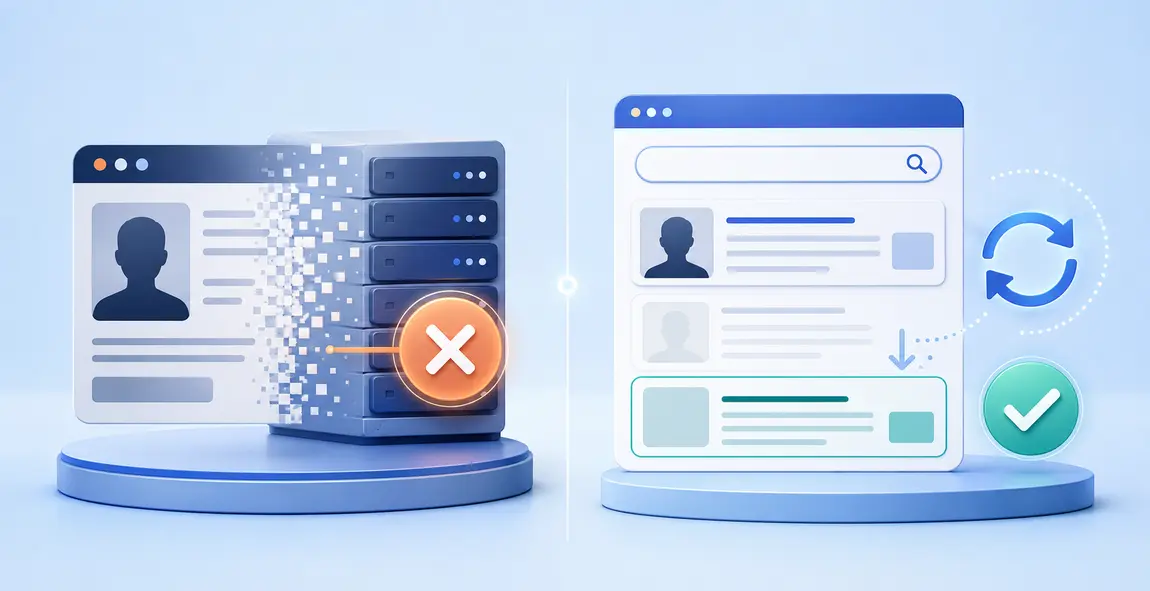
Removing the original webpage or photograph
This means addressing the website or platform hosting the content. Check the page itself and, where available, the direct image URL. A search result disappearing for one query is not sufficient evidence that the source has been deleted. This distinction is central to how our mugshot removal process works.
Removing a result from Google
Google may remove an eligible result while the underlying webpage remains online. Someone could still reach that page through a direct link, another search engine, or a social post. Google explains this limitation in its policy for sites with exploitative removal practices.
Changing an official criminal record
Expungement and limited access concern official records. Pennsylvania State Police explains that its expungement process involves obtaining the record and following up with the county Clerk of Courts about a petition. Use the official Pennsylvania expungement guidance and obtain legal advice about eligibility. An online content-removal service does not itself grant a court order.
What to do if your mugshot is online now
You can organize a removal request while legislative proposals are pending. The checklist below is a practical way to prepare; it is not a statement that every publisher must approve every request.
1. Make a list of exact URLs
Record each webpage, direct image link, and social post separately. Add the date you checked it and save a screenshot. Note whether the problem is an incorrect identity, outdated case information, an unwanted photograph, or a combination. A precise list helps prevent one removed page from being mistaken for complete removal everywhere.
2. Gather accurate case documents
Collect the current disposition and any relevant court orders. Match the person, case number, jurisdiction, and dates to the listing. If you do not understand the disposition, ask your attorney or the court for clarification before describing it to a publisher. Keep a full copy privately and use the recipient’s verified process when supplying necessary documentation.
3. Use the publisher’s current request channel
Look for a corrections, privacy, or removal policy on the actual website. Keep the request factual and specific. Ask what information is necessary, what action the publisher will consider, and how it confirms completion. If your listing is on Arrests.org, our guide to contacting Arrests.org about a removal request explains how to organize the inquiry.
4. Preserve any payment demand
If a publisher or intermediary demands money, save the exact message, amount, payment instructions, and relevant webpage. Ask who controls the content and what the payment would cover. A lawyer can assess the applicable law. Avoid sending a legal threat that treats a pending bill as an enforceable right.
5. Check Google’s existing removal policies
Google already considers requests involving exploitative removal practices. Its stated criteria include that you are the subject of the submitted content, the website is not a business-review site, and payment to the website or other agencies is required for removal. You or an authorized representative can apply. Approval is not automatic. Review Google’s requirements before submitting the URLs.
6. Verify the source and clean up outdated results
After a publisher changes or deletes the content, revisit the original links. If an outdated page description or image still appears in Google, its outdated-content refresh process may be appropriate. That process is intended to update search results after source content changes; it does not compel a publisher to delete a live page.
A clear way to start a publisher request
Adapt this sample to the facts and the website’s policy. Do not claim a dismissal, expungement, or other outcome unless the documents support it.
I am requesting a review of the booking photograph and related information at [exact URL]. The current case status is [accurate status], as shown in [document and date]. Please explain the corrections or removal process available under your policy and what documentation you require. If you remove or update the content, please confirm the affected page and image URLs in writing. Thank you.
Save the request, any confirmation number, and the response. If several websites carry the same photo, track each one individually. The useful question is whether a specific page changed, not whether someone promised to “clean up the internet.”

When professional mugshot removal help may be useful
Consider help when you are dealing with multiple publishers, uncertain request channels, repeated copies, or a source page that has disappeared while search remnants remain. Before hiring anyone, ask for a written scope identifying the URLs, the intended result for each one, the total price, estimated timing, and applicable refund or guarantee terms.
Ask the provider to distinguish its service fee from any charge demanded by a publisher. If a payment arrangement is unclear, get clarification before proceeding. A service agreement should explain the work and its limits rather than rely on a proposed law as a promise of success.
Remove-Arrests.org reviews unwanted online arrest content and develops requests based on the particular websites and circumstances. Our mugshot website removal directory can help you identify the source involved. Legal questions about official record relief or enforcing rights belong with a qualified attorney.
Frequently asked questions
Is Pennsylvania’s proposed mugshot ban already in effect?
No. The HB 2840 record checked November 6, 2026 does not show enactment. Check the official record again before relying on a reported change.
Should I wait for legislation before asking a website to remove my mugshot?
You can review the publisher’s existing policy and prepare an accurate request now. Keep current policy requests separate from any future statutory remedy, and seek legal advice when the applicable law is uncertain.
Does deleting a mugshot from Google delete it from the website?
No. Search removal affects discoverability in that search engine. Confirm the status of the original webpage and image separately; Google’s policy explains that the content may remain available elsewhere.
What should I send Remove-Arrests.org for a review?
Send the URLs and a short, accurate description of what appears online. Identify any relevant case update. The team can explain what it needs to assess the pages, the proposed scope, and pricing before you authorize work.
Need help with an online mugshot?
Get a free, confidential review of the websites and search results involved. We will explain available options, the scope of work, and the cost before you proceed.
Prefer to talk? Call (844) 272-0284.
Sources and verification
Legislative status was checked November 6, 2026. The official bill text controls the proposed provisions discussed here. Recheck it for amendments and later action before relying on this summary.
- Day, Colin. “Proposed Bill Would Ban Publishing Mugshots Online for Profit.” WTAJ, 7 Oct. 2026. Original reporting.
- Pennsylvania General Assembly. House Bill 2840: 2025–2026 Regular Session. Status and history; PN 4007 bill text. Accessed 6 Nov. 2026.
- Briggs, Tim. “Prohibiting Fees to Remove Booking Photographs.” Pennsylvania House of Representatives, 6 Oct. 2026. Co-sponsorship memo.
- Pennsylvania House Judiciary Committee. Vote Summary RCS #3035: HB 2840 PN 4007. 7 Oct. 2026. Committee record.
- Google. “Remove Content About You on Exploitative Sites That Try to Charge for Removal.” Google Search Help. Removal requirements. Accessed 6 Nov. 2026.
- Google. “Refresh Outdated Content.” Google Search Help. Refresh guidance. Accessed 6 Nov. 2026.
- Pennsylvania State Police. “Apply for Criminal Record Expungement.” Commonwealth of Pennsylvania. Official process. Accessed 6 Nov. 2026.
This article provides general information, not legal advice. A Pennsylvania attorney can evaluate rights, eligibility, and enforcement in an individual case.
Want this removed for you?
Talk to a mugshot removal expert — free consultation.
Call (844) 272-0284 Contact Us