Sometimes. A sheriff’s office or county jail will usually remove a booking photo from its own website only when the law requires it, such as after a dismissal, expungement or sealing order, or when a state law limits how long booking photos stay posted. When the agency will not take the page down, you can often get the search result deindexed so it stops showing up when someone Googles your name, and you can remove the copies that commercial mugshot sites made from it.
Government mugshots are different from commercial mugshot sites. The agency is not selling anything, the photo is usually a public record, and there is no “removal fee” to dispute. That changes the strategy. Here is how sheriff and county jail mugshots work, what you can realistically get removed, and what to do when the answer is no.

Where sheriff and jail mugshots show up online
Law enforcement agencies publish booking photos in a few different places, and each one has its own rules:
- Inmate lookup or jail roster: a searchable list of people currently in custody, often with a photo, charges and bond. Many rosters only show current inmates.
- Recent arrests or booking logs: daily or weekly lists of everyone booked, sometimes kept online for months.
- Agency social media: some sheriff’s offices post booking photos on Facebook or X, especially for DUI, drug or theft arrests.
- Press releases and “most wanted” pages: these tend to stay online the longest.
- Third-party jail portals: many counties use vendor software to host their inmate search, so the URL may not end in .gov.
Knowing which one you are dealing with tells you who to contact and what to ask for. If you are not sure whether your booking photo is public in the first place, start with are mugshots public record?
When a sheriff’s office will remove a mugshot
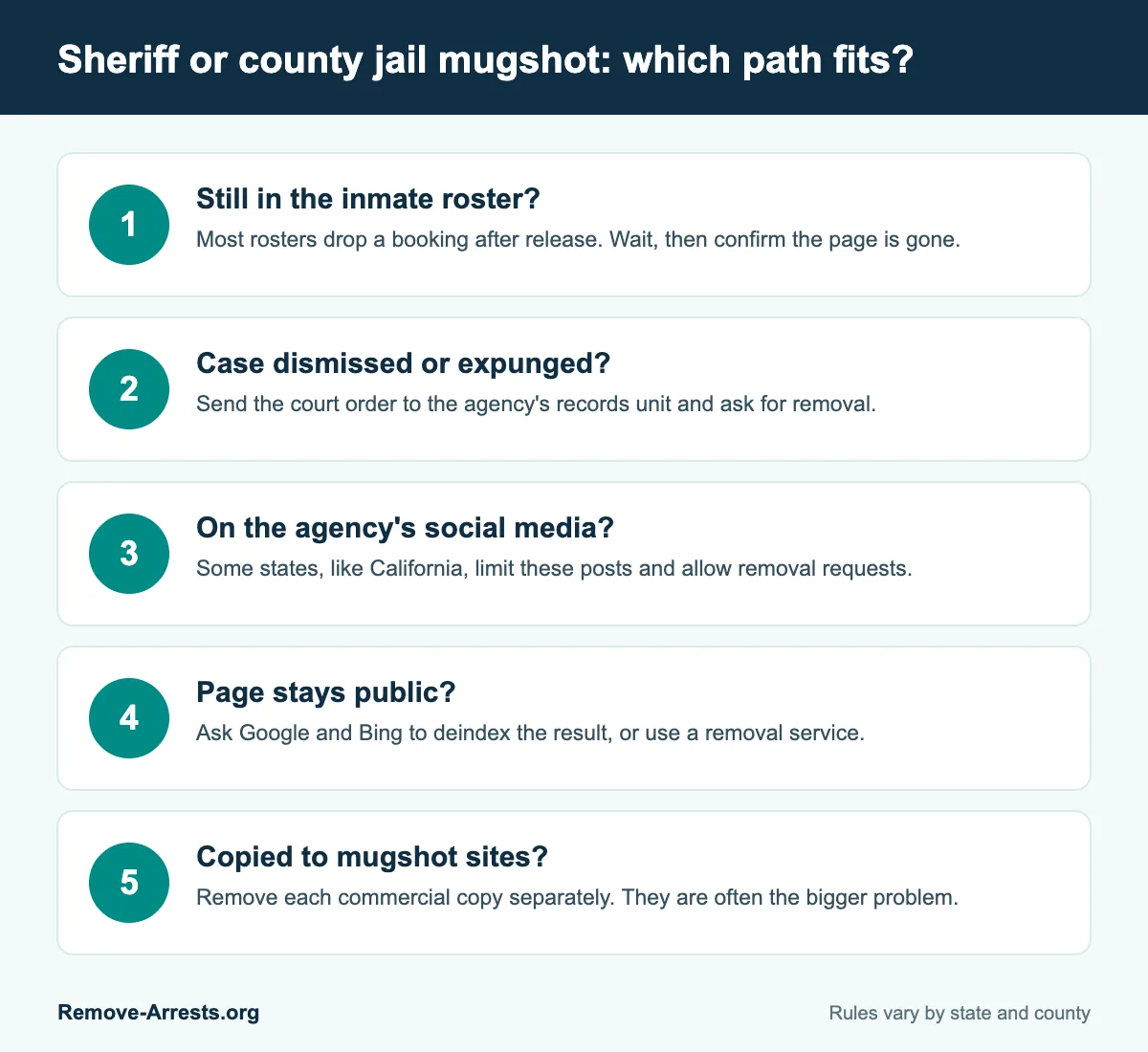
After your release from a current-inmate roster
Many jail rosters are designed to show only people currently in custody. Once you are released, the entry usually disappears on its own within days. If the page is gone but Google still shows it, you can request a refresh with Google’s outdated content tool.
When you have a court order
A dismissal, acquittal, expungement, sealing order or nondisclosure order is the most effective reason to ask an agency to remove a booking photo. Send a short written request to the agency’s records unit with a copy of the order, your booking number and the exact URL. Our guide to mugshot removal after expungement covers what to include.
When a state law limits posting
A growing number of states restrict how long, or whether, law enforcement can publish booking photos:
- California: Penal Code 13665, added by AB 1475 in 2021 and amended in 2023, limits when police and sheriff’s offices can share booking photos on social media for nonviolent offenses, and requires removal from social media in many cases, generally within 14 days unless an exception applies.
- Utah: state law generally prohibits a sheriff from giving out copies of booking photographs except in limited situations, which sharply reduces what Utah agencies publish.
- County policies: some agencies have changed course on their own. Maricopa County stopped posting public mugshots, and others have shortened how long arrest logs stay online.
State laws change often, so check the current rules where you were arrested. Our state-by-state mugshot law guide is a good starting point.
When the agency says no: get the search result deindexed
If the page stays public, the next goal is to stop it from showing up when someone searches your name. A government page that is not indexed is far harder to find, and most people never look past the first page of Google.
- Check whether the page is still live. If it returns an error or no longer shows your photo, submit it to Google’s outdated content tool and Bing’s Content Removal Tool.
- Ask the agency to block indexing. Some IT departments will add a noindex tag or block search engines from crawling booking pages, even if they keep the page itself.
- Use Google’s personal information tools where they apply, such as Results about you for contact details shown alongside the record.
- Work with a removal service experienced with government pages. Deindexing a county jail or sheriff’s page is harder than removing a commercial mugshot site, and it often takes more documentation and follow-up.
Do not forget the commercial copies
For most people, the sheriff’s page is not the biggest problem. Commercial mugshot sites scrape county jail data every day, and their pages often rank higher than the original government page. Removing those copies usually does more for your search results than fighting over the jail roster. See the full list of mugshot sites we remove from, or start with a free review and we will map every copy for you.
How long do sheriff’s offices keep mugshots online?
It depends on the county. Current-inmate rosters may drop a booking within days of release. Arrest logs might stay up for 30 to 90 days or longer, and social media posts can stay indefinitely unless a state law or agency policy says otherwise. Our guides on how long it takes to release a mugshot and how long mugshots stay online explain the timing in more detail. For examples of how individual counties publish arrests, see our guide to the Hillsborough County arrest inquiry.
A simple removal request you can send to a sheriff’s office
Keep it short, polite and specific. Include:
- Your full name and date of birth as booked
- Your booking number and booking date
- The exact URL where the photo appears
- The reason: release from custody, dismissal, expungement, sealing order or a specific state law
- A copy of any court order
- A request to remove the photo, or to block search engines from indexing the page if removal is not allowed
Send it to the records unit or public information officer, keep a copy, and follow up after two weeks if you do not hear back.
Government page vs. commercial mugshot site: what is different
| Sheriff or county jail page | Commercial mugshot site | |
|---|---|---|
| Who runs it | A government agency | A private business |
| Is the photo a public record? | Usually yes | It is a copy of one |
| Removal on request? | Only when law or policy requires it | Often possible through policy, state law or a removal service |
| Typical leverage | Court orders, state booking-photo laws | Site policies, state mugshot laws, search engine policies |
| Search engine fix | Deindex once the page changes | Remove at source, then deindex |
| Difficulty | Higher | Lower |
In practice, a good plan handles both at once: remove the commercial copies, which usually rank higher, and work on the government page through the agency or search engines.
How to find out your county’s booking photo policy
Most agencies do not publish a clear “mugshot removal policy,” but the information is usually available if you know where to look:
- Check the inmate search page itself. Footer notes often say how long records stay up and whether released inmates are shown.
- Look for a public records or open records page. It names the records custodian and explains how to request changes.
- Search the agency’s site for “booking photo,” “mugshot” or “arrest log.” Some sheriff’s offices post their social media or press release policy.
- Call the records unit. Ask two questions: how long booking information stays online, and whether they remove photos after dismissal or expungement.
- Check your state’s laws. A state statute can override an agency’s habits, especially for social media posts.
Write down who you spoke with and what they said. If the agency later declines a request, that record helps you or your lawyer follow up.
Why the sheriff’s page may not be your biggest problem
People often focus on the government page because it feels official. In search results, though, the commercial copies usually do more damage:
- They rank higher, because they are built to attract search traffic.
- They stay up longer, often for years after the jail roster has dropped the booking.
- They add ads, “related arrests” and sometimes your age and address, which makes the page look worse than the original record.
- They get copied by other sites, so one listing becomes several.
When you search your name, count how many results come from government sites and how many come from commercial mugshot sites. For most people, removing the commercial copies clears most of page one, even if the sheriff’s page stays exactly where it is.
What a mugshot removal service can and cannot do with government pages
A removal service cannot order a sheriff’s office to delete a public record. What an experienced team can do is:
- Identify every copy of the booking, government and commercial.
- Remove the commercial copies at the source and deindex them.
- Prepare requests to the agency based on your case outcome and state law.
- Request search engine removal once the government page changes or is taken down.
- Monitor for new copies created from the same county data.
Government pages take more time and documentation than commercial mugshot sites, so expect a longer timeline and ask for a clear explanation of what is and is not included before you agree to any work.
Police department pages vs. sheriff’s office pages
City police departments and county sheriff’s offices often publish arrests in different ways. Police departments are more likely to post press releases or daily activity logs, while sheriff’s offices usually run the county jail and its inmate lookup. If you were arrested by a city officer and booked into the county jail, your information may appear on both agencies’ sites. Send each agency its own request, because one agency cannot remove the other’s records. The same applies to state police and highway patrol arrests, which may be booked into a county jail but announced on a state website or social media account.
Frequently asked questions
Can you remove a mugshot from a sheriff’s website?
Sometimes. Agencies usually remove booking photos after release from a current-inmate roster, when there is a court order such as an expungement, or when state law limits posting. Otherwise the page may stay up, but the search result can often be deindexed.
Are county jail mugshots public record?
In most states, yes. That is why agencies publish them and why mugshot sites can copy them. A few states restrict release of booking photos, so it depends on where you were arrested.
Can Google remove a mugshot from a government website?
Google rarely removes live, lawful government pages from search, but it does remove results for pages that are gone or changed, and some personal details under its personal information policies. Deindexing a government page usually requires the page to change first.
How do I get my mugshot off a sheriff’s Facebook page?
Ask the agency in writing to remove the post, especially if your charges were dropped or reduced. In California, state law limits these posts and gives you a way to request removal. You can also report the post to Facebook if it breaks platform rules.
Is removing a mugshot from a county website different from a mugshot site?
Yes. Commercial mugshot sites are private businesses and are usually easier to remove. Government pages are public records, so the focus is on court orders, state law and deindexing.
Need a county jail or sheriff mugshot cleared from Google?
Tell us where your booking photo appears. We will check the government page and every commercial copy, explain what can be removed or deindexed, and quote the work before you decide.
Request a free review or call (844) 272-0284
Want this removed for you?
Talk to a mugshot removal expert — free consultation.
Call (844) 272-0284 Contact Us