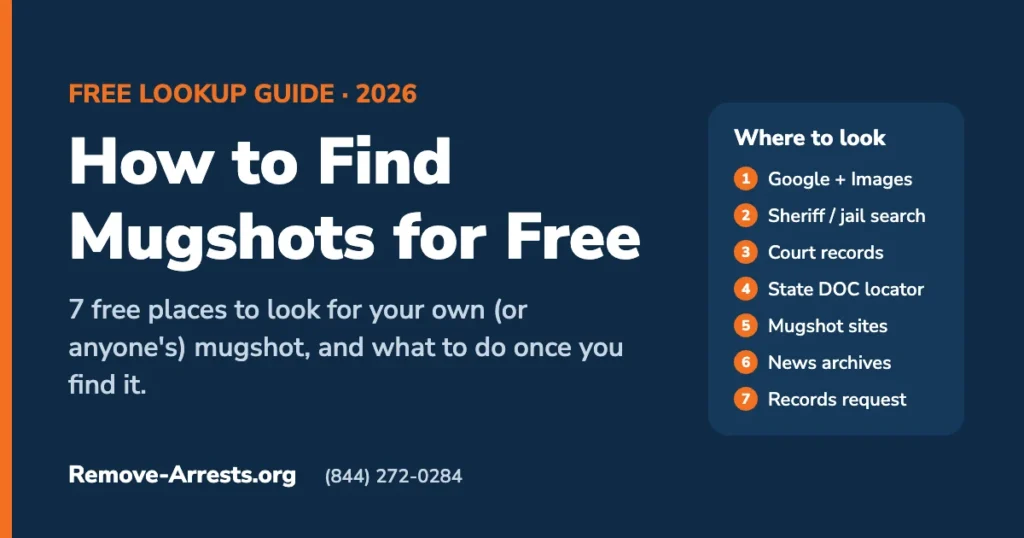
Whether you’re checking your own record before a job interview or looking up someone you just met, you can usually find a mugshot for free. Booking photos start at the arresting agency, and the free sources closest to that agency (the sheriff’s jail search, the county court site and Google) are often enough. This guide walks through seven free places to look, how to find an old or past mugshot, what you can’t find for free, and what to do if you find your own photo online.
Short answer: To find a mugshot for free, search the person’s full name plus the city or county and “mugshot” or “arrest” on Google and Google Images, then check the county sheriff’s inmate or booking search, the county or state court records portal, and the state Department of Corrections inmate locator. If you still can’t find it, ask the arresting agency for a copy through a public records request. Paid “background report” sites usually aren’t necessary.
How to Find a Mugshot for Free: 7 Places to Look
- Google and Google Images: search the full name with the city, county or state and words like “mugshot,” “arrest” or “booking.”
- The county sheriff or jail inmate search: most jails post recent bookings, often with a photo.
- Court records: county and state court portals show charges, case numbers and outcomes for free.
- The state Department of Corrections (DOC) inmate locator: useful if the person was sentenced to state prison.
- Mugshot and arrest websites: these sites copy booking photos, and searching them is usually free.
- Local news and police social media: crime blotters and department pages sometimes post booking photos.
- A public records request: ask the arresting police department or sheriff’s office for the booking photo.
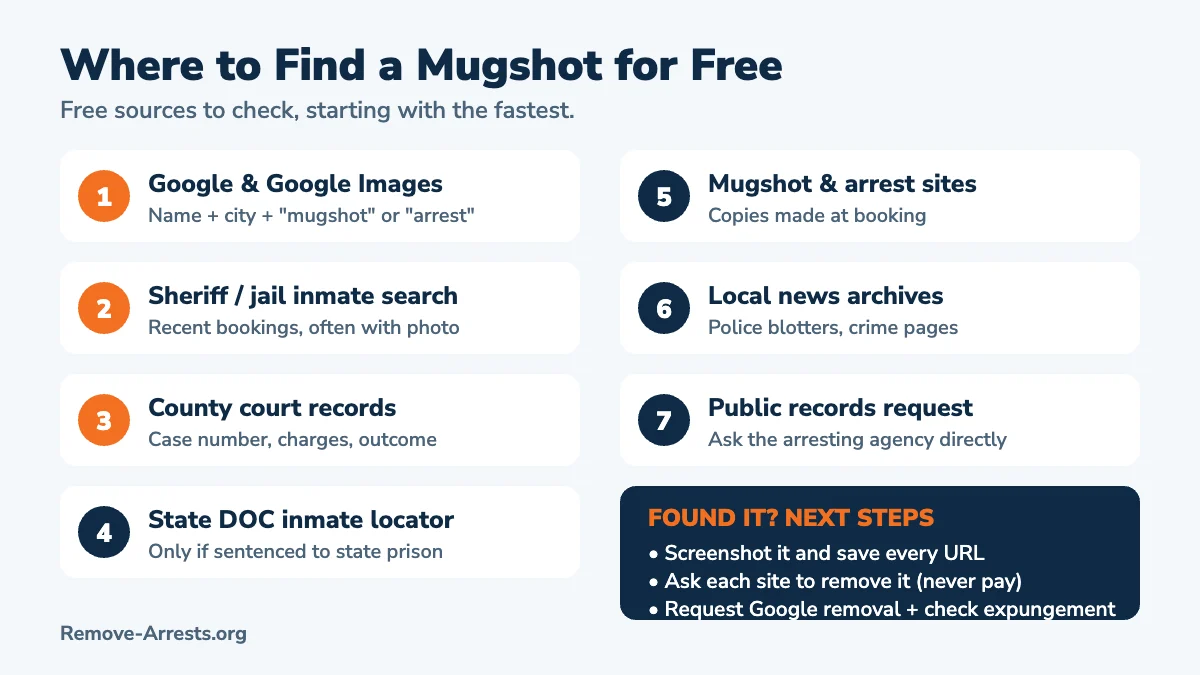
Before you search, gather what you know: full legal name (and any nicknames or maiden names), approximate date of birth, the city or county where the arrest happened, and a rough date. The more of these you have, the faster you’ll rule out people with the same name.
Are Mugshots Public Record?
In most states, booking photos are treated as public records, but the rules vary a lot. Each state has its own public records law, and agencies can withhold photos in some situations, such as an open investigation, a juvenile arrest or a record that has been sealed or expunged. The federal Freedom of Information Act (FOIA) covers federal agencies only, so local mugshots fall under your state’s law, not FOIA.
Some states also limit how police share mugshots. In California, for example, Penal Code 13665 (added by AB 1475 in 2021 and amended by AB 994 in 2023) bars police departments and sheriff’s offices from sharing booking photos on social media for most nonviolent arrests, with limited exceptions, and requires removal within 14 days. For a state-by-state look, read are mugshots public record?
Step 1: Search Google and Google Images
Google is the fastest free starting point because it indexes sheriff pages, mugshot sites, court sites and news stories at once. Try searches like these:
- “First Last” mugshot (use quotation marks around the name)
- “First Last” arrest [city or county]
- “Last, First” booking [state] (many jail sites list last name first)
- “First Middle Last” [county] inmate
Then switch to the Images tab, since a mugshot can show up there even when the page itself ranks poorly. If you already have the photo, use reverse image search (Google Lens, the camera icon in Google Images) to see every site where the same image appears. Repeat the search on Bing, which sometimes shows different results.
Step 2: Check the Sheriff or Jail Inmate Search
Most county sheriff’s offices run the local jail and post an inmate search, booking log or “recent arrests” page. Search “[county name] sheriff inmate search” or “[county name] jail booking.” These pages usually show the booking photo, charges, bond and booking date. Many of them only list people who are in custody or were booked recently, so an older arrest may no longer appear.
Some large counties have their own lookup tools. See our guides for Hillsborough County arrest inquiry, Harris County mugshots and Orange County mugshots. In a city, the police department may handle bookings instead of the sheriff, so check both.
Step 3: Search County and State Court Records
Court records rarely include the photo itself, but they confirm the arrest, charges, case number, dates and outcome, which is exactly what you need to request the mugshot or to check whether the case was dismissed. Many states have a free statewide portal (Missouri’s Case.net is one example); others are searched county by county through the clerk of court. Federal cases are on PACER, which charges $0.10 per page with a $3 cap per document, and fees are waived if you spend $30 or less in a quarter.
Step 4: Use the State DOC Inmate Locator
If the person was sentenced to state prison, the state Department of Corrections inmate locator often shows a recent photo, offense, sentence and release date. Search “[state] DOC inmate locator.” Many states keep released inmates in the search for years. The federal Bureau of Prisons inmate locator covers federal inmates back to 1982, but it generally doesn’t show photos.
Most states also run a free sex offender registry with photos, and the national site NSOPW.gov searches them all at once. It only covers registered offenders, though, not ordinary arrests.
Step 5: Search Mugshot and Arrest Websites
Private mugshot sites copy booking photos from jail websites, sometimes within a day or two of the arrest, and keep them long after the jail’s own page is gone. Searching them is usually free. Common ones include Mugshots.com, Arrests.org (who runs it), Mugshots.Zone (who runs it), BustedNewspaper and regional sites. See our guide to mugshot websites for a longer list.
Be careful with sites that show a teaser, then ask you to pay for a “full report.” The paid report usually pulls the same public data you can find free in steps 1 through 4, and some of these sites are people-search sites rather than true mugshot sites.
Step 6: Check Local News and Police Social Media
Local newspapers, TV stations and weekly “busted” papers often publish booking photos, especially for serious or newsworthy arrests. Search the news site’s archive or Google News for the name plus the town. Police and sheriff’s Facebook pages sometimes post mugshots too, though some states, such as California, now restrict this.
Step 7: Request the Mugshot From the Arresting Agency
If you can’t find the photo online, ask for it. Contact the records division of the police department or sheriff’s office that made the arrest and submit a public records request (some agencies have an online portal). Include the full name, date of birth, arrest date and case or booking number if you have it. Agencies may charge a small copy fee, may ask for ID if you’re requesting your own record, and may deny the request if the case is open, sealed or expunged.
How to Find an Old or Past Mugshot for Free
Old mugshots are harder because jail sites usually drop bookings after a while. Try these in order:
- Search Google and Google Images with the name plus the year of the arrest.
- Check the large mugshot sites, which often keep photos for years.
- Search the court record to confirm the agency, date and case number.
- Look up old copies of a page with the Internet Archive’s Wayback Machine (archive.org), if you know the URL.
- Send a public records request to the arresting agency, which may still have the photo on file even if it’s no longer online.
If the record has been sealed or expunged, the agency usually can’t release it, which is good news if it’s your own record. Learn how that interacts with websites in mugshot removal after expungement.
How to Find Your Own Mugshot Online
If you were arrested, it’s worth checking what an employer, landlord or date will see. Search your name the way they would, in a private or incognito window so your search history doesn’t change the results. Check:
- Google web results and Google Images for your full name, with and without your middle name or initial
- Your name plus your city, county and the arrest year
- The main mugshot sites and people-search sites
- Bing and DuckDuckGo
- A reverse image search, if you have a copy of the photo
Make a list of every URL you find. You’ll need it to request removal, and it helps you notice if the photo spreads to new sites later. Setting a free Google Alert for your name is an easy way to watch for new results.
Search Tips That Save Time
- Try name variations. Jails often record the full legal name, so “Robert” may be listed instead of “Bob,” and hyphenated or maiden names may be split.
- Search last name first. Many booking logs and court portals sort by last name, and some only accept “Last, First.”
- Narrow by date of birth. Court and DOC searches often let you filter by birth date or age, which separates people with common names.
- Find the right agency. An arrest on a highway may have been made by the state patrol, and a campus arrest by university police, not the city or county.
- Check neighboring counties. People are often booked into the jail of the county where the arrest happened, not where they live.
- Use the booking or case number. Once you have it from a court record, it’s the fastest way to pull up the exact booking or request the photo.
If a name is very common, confirm you have the right person before drawing any conclusions. Match at least two details, such as date of birth, middle name or address, and remember that a booking photo alone doesn’t tell you whether the person was convicted.
Free vs. Paid Mugshot Search Options
| Source | Cost | Shows photo? | Best for |
|---|---|---|---|
| Google / Google Images | Free | Often | Seeing what others see |
| Sheriff or jail inmate search | Free | Usually | Recent bookings |
| Court records portal | Free (PACER has fees) | Rarely | Charges and outcome |
| State DOC inmate locator | Free | Often | People sentenced to prison |
| Mugshot websites | Free to search | Yes | Copies kept after the jail drops them |
| Public records request | Free or small fee | Yes | Older or hard-to-find photos |
| “Background report” sites | Paid | Sometimes | Rarely needed |
How Long Do Mugshots Stay Online?
It depends on where the photo is. Jail and sheriff booking pages are often short-lived: many only show people currently in custody or booked within the last few days or weeks. Court records stay available much longer unless they’re sealed or expunged. Private mugshot sites and people-search sites are the problem, because they can keep a copy indefinitely and other sites can copy it again. That’s why a mugshot you can’t find on the sheriff’s site may still be the first thing that shows up when someone Googles your name. See how long mugshot removal takes if you want yours taken down.
What You Usually Can’t Find for Free
- Sealed or expunged records: agencies generally can’t release them.
- Juvenile arrests: usually confidential.
- Photos an agency withholds: for example during an active investigation, or where state law limits release.
- Very old records: some agencies purge or archive older booking photos.
Using Someone Else’s Mugshot Responsibly
Looking up a mugshot for personal safety is legal in most places, but using it is a different matter. An arrest isn’t a conviction, and many charges are dropped. If you’re screening someone for a job, apartment, loan or insurance, the federal Fair Credit Reporting Act (FCRA) generally requires using a consumer reporting agency and following its rules, not a free mugshot or people-search site. Some states also limit how employers can use arrest records.
Found Your Mugshot? What to Do Next
- Document it. Screenshot each page and save the URLs.
- Never pay a mugshot site to take it down. Many states ban removal fees, and paying one site does nothing about the others. See mugshot website laws.
- Ask each site to remove it. Some remove photos for dismissed, sealed or expunged cases. Here is how to contact Arrests.org.
- Clean up Google. Once a page is removed or changed, use Google’s outdated content tool so the old result and thumbnail drop out. See 3 ways to remove a mugshot from Google.
- Check if you qualify for expungement or sealing. It closes official records, which helps with background checks and removal requests. Read expungement vs. mugshot removal.
- Get help if it’s on many sites. Our mugshot removal service handles every site and search engine for you.
If you compare services, ask what happens if the mugshot comes back, whether they’ll remove it again at no additional cost, how long the warranty lasts, and whether the price and terms are confirmed in writing before work starts. Our comparison of mugshot removal services covers what to look for, and will my mugshot come back after removal? explains why re-postings happen.
Frequently Asked Questions
How do I find a mugshot for free?
Search the full name plus the city or county and “mugshot” on Google and Google Images, then check the county sheriff’s inmate search, the court records portal and the state DOC inmate locator. If none of those show it, request the booking photo from the arresting agency.
How can I find my own mugshot online?
Search your full name, with and without your middle name, plus your city and the word “mugshot” in a private browser window. Check Google Images, the main mugshot websites, people-search sites and Bing, and save every URL you find.
How do I find an old mugshot for free?
Search Google with the name and arrest year, check the large mugshot websites, confirm the case in court records, and send a public records request to the arresting agency, which may still have the photo on file.
Is there a free mugshot search engine?
There is no single official free mugshot database. Google and Google Images work as the best free search engine because they index sheriff sites, mugshot sites and news at once. Sheriff, court and DOC sites are free official sources.
Are mugshots public record?
In most states booking photos are public records, but rules vary. Agencies may withhold photos for open investigations, juvenile cases or sealed and expunged records, and some states limit how police share them.
Why can’t I find a mugshot online?
The jail may have removed the booking from its site, the record may be sealed or expunged, the agency may not post photos, or the name may be spelled differently. Try variations and a public records request.
Do I have to pay a website to see a mugshot?
Usually not. Paid background report sites mostly repackage public data you can find for free from Google, sheriff sites, court records and the arresting agency.
What should I do if I find my mugshot online?
Save the URLs, never pay a mugshot site for removal, ask each site to remove it, use Google’s outdated content tool once pages change, and check whether you qualify for expungement or sealing. A removal service can handle many sites at once.
Want Your Mugshot Gone for Good?
Finding your mugshot is the first step. Remove-Arrests.org, a Defamation Defenders website, removes mugshots and arrest records from mugshot sites, people-search sites and search engines. Get a free, confidential case review online or call (844) 272-0284. Start with our mugshot removal page.
This guide is for general information, not legal advice. Public records laws differ by state and change over time; check your state’s current rules or talk to a lawyer about your situation. Current as of November 2026.
Want this removed for you?
Talk to a mugshot removal expert — free consultation.
Call (844) 272-0284 Contact Us